The short answer: the best yacht stabilizer is the one that fits the size of your boat, the way you use her and the space and power she has available. For most motor yachts that want comfort at anchor as well as underway, a gyroscopic stabilizer such as a Seakeeper is the usual choice. Fin stabilizers suit larger boats that spend most of their time cruising, ride-control systems help smaller planing boats, and passive solutions such as ballast and anti-roll tanks cover the basics. This guide explains each type, how Seakeeper gyros work, how to choose the right model, and what installation and maintenance involve in Mallorca.

In this guide
- Why stabilise a yacht at all
- Types of yacht stabilizers
- Seakeeper gyroscopic stabilizers
- Seakeeper models by boat size
- Seakeeper Ride for smaller boats
- Fin stabilizers and Sleipner Vector Fins
- How to choose the right stabilizer
- Installation in Mallorca
- Maintenance and service
- What does a stabilizer cost?
- Frequently asked questions
Why stabilise a yacht at all
Roll is the sideways rocking of a boat, and it is what most people mean when they say a yacht is uncomfortable. It makes walking on deck harder, spills drinks, spoils sleep at anchor and tires crew and guests. Over a long passage it leads to seasickness and fatigue, and in rough conditions it affects safety and the ability of the crew to work.
A good stabilizer reduces roll, so the boat feels calmer in the same sea. The benefits are practical:
- More comfort for owners and guests, especially at anchor in the bays of Mallorca where a small swell can make a night unpleasant.
- Safer movement around the deck, with less risk of falls.
- Less fatigue for crew on long passages.
- More days of usable cruising when the sea is not flat.
- A feature that can add to the resale value of the boat.
Types of yacht stabilizers
There are five main families. They are not mutually exclusive, and larger yachts sometimes combine two of them.
| Type | How it works | At anchor? | Best for | Points to consider |
|---|---|---|---|---|
| Ballast and weight distribution | Weight low in the hull makes the boat more stable | Yes, but limited | Small yachts and sailing yachts | Passive, no moving parts, but only a basic effect |
| Anti-roll tanks | Water moves between tanks and counters the roll. Passive tanks rely on the natural movement of the water, active tanks use sensors and pumps | Yes | Larger yachts and ships | Take up a lot of space and weight |
| Fin stabilizers | Underwater fins on the hull generate a force against the roll | Only with zero-speed designs | Larger yachts that cruise a lot | Appendages outside the hull, need hull penetrations and space |
| Gyroscopic stabilizers | A spinning flywheel in a sealed sphere produces a counter-force against the roll | Yes | Motor yachts and sailing yachts from about 30 feet to superyachts | Need space for the unit and electrical power |
| Ride-control systems | Blades and a control system adjust the boat’s attitude while underway | No | Smaller planing boats | Work underway, not at rest |
For an owner choosing equipment today, the real choice is usually between a gyroscopic stabilizer and fins, with ride control as an option for small powerboats. Ballast and tanks are decisions that are made at the design stage of a boat.
Seakeeper gyroscopic stabilizers
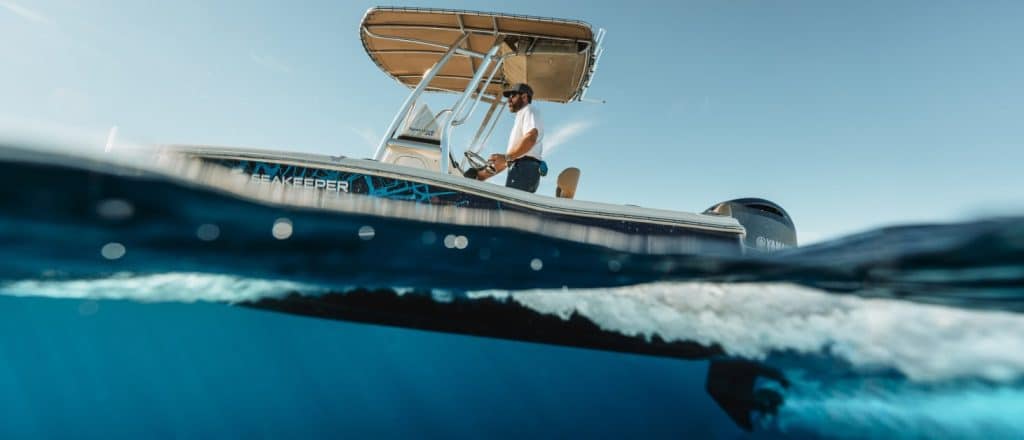
Seakeeper is a gyroscopic stabilizer. Inside a vacuum-sealed sphere, a flywheel spins at high speed. When the boat rolls, the system reacts to the movement and produces a force in the opposite direction, which cancels most of the roll. Sensors detect the boat’s movement, and the control unit manages the process automatically.
Three features make it popular:
- It works both underway and at anchor. Traditional stabilizers that depend on water flow only help while the boat is moving. A gyro keeps working when you stop.
- It reduces roll by up to 95%, depending on the vessel and the sea conditions.
- It sits inside the hull. There are no outside fins or appendages, which also means no extra drag or risk of damage to a fin.
Our page on Seakeeper in Mallorca describes the full range, installation and service. PSB Marine is a Seakeeper official dealer in Mallorca and was awarded Best Seakeeper Service EMEA at METS Trade 2019.
Seakeeper models by boat size
The right model depends on the size, displacement and layout of the vessel. The ranges below are the approximate sizes published by Seakeeper for each model; our technicians confirm the correct choice for your boat after a technical assessment.
| Model | Approximate boat size | Notes |
|---|---|---|
| Seakeeper 2 | About 30 to 36 ft | Smaller and lighter, eliminates up to 95% of roll |
| Seakeeper 3 | About 35 to 41 ft | Designed to eliminate roll on boats of this size |
| Seakeeper 4.5 | About 40 to 46 ft | 50% more stabilizing power than the Seakeeper 3; runs on AC power, for boats with a generator |
| Seakeeper 6 | About 44 to 53 ft, up to about 24 tons | 6,000 N-m-s of stabilizing power |
| Seakeeper 9 | About 50 to 60 ft, up to about 30 tons | Evolution of the original M7000 |
| Seakeeper 18 | About 60 to 75 ft, up to about 56 tons | Completely internal, modest electrical power |
| Seakeeper 26 | About 70 to 85 ft, up to about 75 tons | No outside appendages, modest electrical power |
| Seakeeper 40 | 85 ft and up, up to about 115 tons | Field replaceable bearings; several units can be fitted on larger boats |
Seakeeper gyros suit motor yachts, sport fishing boats, luxury cruisers, catamarans, superyachts, and day boats and tenders.
Seakeeper Ride for smaller boats
Seakeeper Ride is a different product for smaller powerboats. It uses blades and a control system to give pitch and roll stability while the boat is underway. It is offered in three sizes, according to the boat length:
- Seakeeper Ride 450: boats up to 26 ft, 450 mm blades.
- Seakeeper Ride 525: boats of 27 to 30 ft, 525 mm blades.
- Seakeeper Ride 600: boats of 31 to 35 ft, 600 mm blades.
All three work on 12 V with a power draw of 7 to 8 A at cruising speed, according to the manufacturer data shown on our page. Because Ride acts when the boat is moving, it is a good match for a day boat or a sport boat that spends its time underway. If you want comfort at anchor as well, a gyro is the better answer. See Seakeeper Ride in Mallorca for models and details.
Fin stabilizers and Sleipner Vector Fins
Fin stabilizers are underwater wings fitted on both sides of the hull. As water flows over them, the system adjusts their angle to produce a force against the roll. Traditional flat fins work best when the boat is moving.
The Sleipner Vector Fins, which PSB Marine offers in Mallorca, are a modern fin design. According to the manufacturer information on our Sleipner page:
- The curved shape generates lift while reducing drag, which turns more energy into stabilization.
- The electric actuator separates the high-torque gears and motor from the boat and reduces structural noise by about 92%, which matters when stabilising overnight.
- On faster boats the lift can reduce fuel consumption, by up to 12% on average compared with traditional flat fins.
- At anchor, the fins can reduce roll by as much as 90% and often give twice the stabilizing force per kilowatt of input compared with flat fins.
Fins suit larger yachts that spend most of their time cruising, where the extra efficiency and long-range comfort matter most. The trade-off is the work needed to fit them: hull penetrations, reinforced structure and space for the actuators, which is why they are normally planned for a refit.
How to choose the right stabilizer
- Start with how you use the boat. If you spend nights at anchor or in bays, you need a system that works at rest, which means a gyro or zero-speed fins. If the boat is mostly underway, fins or ride control also work well.
- Know your size and displacement. The model depends on length, weight and layout. Ask for a technical assessment instead of choosing from a brochure.
- Check the space. A gyro sits in the engine room or a technical space. Fins need access to the hull and room for the actuators.
- Check the electrical power. Some models run on DC and others on AC, which means a generator. Power availability can decide between two otherwise similar options.
- Think about the work. A gyro usually involves less hull work than fins. Fins normally need the boat out of the water.
- Plan the timing. The best moment to install a stabilizer is during a winter lay-up or a refit, when the boat is out of use and access is easy.
- Think about service. Choose a system with a service network close to where the boat is based.
Installation in Mallorca
PSB Marine carries out complete Seakeeper installations in Mallorca, tailored to each vessel. Every installation is performed according to manufacturer specifications. Our process includes:
- Initial technical assessment of the yacht.
- Selection of the appropriate Seakeeper model.
- Structural preparation and engineering review.
- Mechanical and electrical installation.
- System commissioning and calibration.
- Final testing and sea trials.
Installing a stabilizer often goes hand in hand with other work, such as electrical upgrades, interior changes and paint. That is why many owners schedule it within a winter project. See our yacht refit service in Mallorca, and our winter storage, where the boat can be kept under cover while the work is done. To plan an installation, contact our team.
Maintenance and service
Seakeeper gyros are designed to need minimal maintenance, because most of the critical components work inside a sealed enclosure protected from moisture. Outside the sphere, the closed-loop hydraulic circuit and the cooling circuit should be inspected and serviced periodically. The routine service is set out in the scheduled maintenance table in the operation manual; see our article on the Seakeeper recommended maintenance schedule.
Our Seakeeper service in Mallorca includes routine inspections and diagnostics, preventive maintenance, software updates, cooling system inspections, component replacement when required and technical troubleshooting and repairs. If your system shows alarms, unusual vibration or performance problems, our technicians can diagnose and repair it, so the boat is back in working order as soon as possible. Regular servicing helps to extend the life of the system and avoid downtime in the busy summer season.
What does a stabilizer cost?
The price depends on the type of system, the model and the installation work. Our Seakeeper Ride page shows manufacturer retail prices of $4,500 for the Ride 450, $7,500 for the Ride 525 and $10,500 for the Ride 600. For gyroscopic stabilizers, as an orientation, prices start at around 20,000 euros for the smallest models and can reach 100,000 euros or more for the largest, before installation. The only reliable figure is a written quotation for your boat, which includes the unit, the installation work and the commissioning. Request a quote and we will tell you what applies to your boat.
Frequently asked questions
What is the best yacht stabilizer?
It depends on the boat and how you use her. A gyroscopic stabilizer such as Seakeeper is the usual choice when comfort at anchor matters. Fin stabilizers suit larger boats that cruise a lot, and ride control suits smaller planing boats.
Do gyro stabilizers work at anchor?
Yes. A Seakeeper gyro reduces roll both underway and at anchor, which is one of its main advantages over stabilizers that depend on water flow.
How much roll does a Seakeeper remove?
Depending on the vessel and the sea conditions, Seakeeper systems can reduce roll by up to 95%.
Which Seakeeper model do I need?
It depends on the size, displacement and layout of the boat. The Seakeeper 2 is for boats of about 30 to 36 ft, and the range goes up to the Seakeeper 40, for boats of 85 ft and more. Our technicians confirm the right model after assessing your boat.
What is the difference between a Seakeeper and fin stabilizers?
A Seakeeper gyro sits inside the hull and works at rest and underway. Fins are underwater appendages that work best when the boat is moving, unless they are zero-speed designs such as the Sleipner Vector Fins, which also reduce roll at anchor.
How long does a stabilizer installation take?
It depends on the boat, the model and the work needed around it, so we give the plan in writing after the technical assessment. Winter is the best time because the boat is not in use.
Does a Seakeeper need maintenance?
Very little, since the critical parts work in a sealed enclosure. The hydraulic and cooling circuits outside the sphere should be inspected and serviced periodically, following the manufacturer’s maintenance schedule.
Can PSB Marine install and service stabilizers in Mallorca?
Yes. We are an official Seakeeper dealer in Mallorca and we handle assessment, installation, commissioning, sea trials, maintenance and repairs, and we also offer Sleipner Vector Fins.
Talk to PSB Marine about stabilizers
Tell us the length and type of your boat and how you use her, and we will recommend a solution. See the pages for Seakeeper, Seakeeper Ride and Sleipner Vector Fins, or write to info@psb-marine.com or call 971 234 522.